KB [00:00:10]:
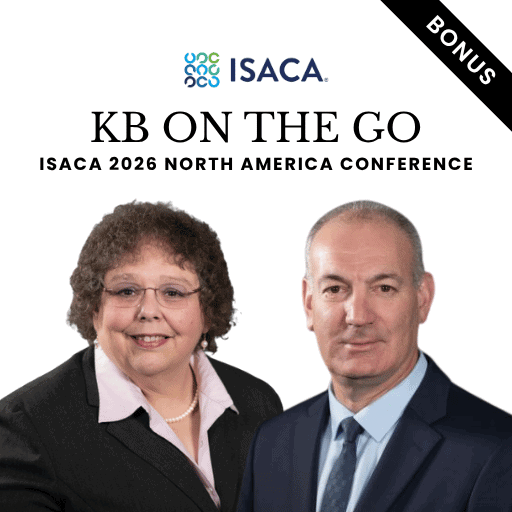
What’s up everyone? It’s KB and I’m on the go. At ISACA’s North American Conference in Las Vegas this week, some of the biggest conversations shaping networking, AI and cyber security are all happening at once. This week is where operators, engineers and executives get into the detail of what’s working, what’s not and what’s actually changing inside enterprise environments at scale. We’re hearing a lot about AI driven networking, automation and visibility, but the real question is how does that translate into security outcomes, operational resilience and ultimately cost? Because behind every intelligent network claim, there’s a small human team trying to make sense of complexity. Across the next few segments, we’ll be speaking with leaders on the ground unpacking what’s real, what’s noise and where the industry is genuinely heading next. This is KB on the go from Las Vegas. Let’s get into it. Joining me now in person is Pam Nigro, Senior Vice President of Security and Security Officer at Medicision and Board Director of ISACA.
KB [00:01:20]:
And today we’re discussing the supply chain and how vulnerable is it’s become right now. So Pam, thanks for joining me and welcome.
Pam [00:01:25]:
Thank you. Glad to be here.
KB [00:01:27]:
Okay, so Pam, really want to get into it considering we’re on a bit of a short timeline, but I want to get your thoughts around why the supply chain has become one of the most vulnerable areas in cyber security right now. Talk me through it.
Pam [00:01:41]:
Supply chain is the most vulnerable right now strictly because we are all using SaaS solutions. And even if you think about your Microsoft products, right, if you think about our Gmail products or whatever those products are, you’re connecting through a SaaS solution and not understanding that entire end to end kind of chain really exposes you. And think about all the APIs you have and you connect out to this app or to that app, all of that data gets transacted back and forth within your own system. But if you only focus on what is in your system and not looking beyond your systems, you, you’re going to miss quite a bit.
KB [00:02:22]:
And would you say people aren’t looking beyond their systems because perhaps they’re just super focused on what they’ve got to do day to day and these things go by the wayside.
Pam [00:02:32]:
It is difficult to make sure that you do that. But there is ways to help, right? There are ways to facilitate that you certainly can have, when you’re doing the contract negotiations, have conversations around that you can also do. There’s some technologies that you can use and I don’t want to give any brand names away. But that can kind of help you go up and down your supply chain to see what your, what vulnerabilities you may be exposed to. You can ask your suppliers, obviously not Microsoft, but you can ask your suppliers if they’ve done a vulnerability testing recently or if they’ve done a pen testing recently and what those results were.
KB [00:03:09]:
And would you say as well, like nowadays, like companies have to leverage suppliers. Like, it’s very hard to do anything nowadays without leveraging other companies. So there’s so many interdependencies. Do you think it’s in terms of the interdependency tendencies? It’s something that’s crept up on companies because perhaps even 10, 15, 20 years ago, we had a lot less external suppliers that we’re using now. You know, look at the catering company and all the tools that we leverage, even for security and technology. Do you think it’s something that perhaps people haven’t considered when they’ve been building their programs and now it’s sort of just the straw that broke the camel’s back?
Pam [00:03:47]:
Would you say there’s a misinterpretation? A lot of people believe it belongs into the vendor risk management program, which is, it’s a different mindset, it’s a different set of problems that you’re trying to solve for other than vendor risk. A lot of vendor risk programs grew up with, you know, meeting SLAs and qualities and, you know, contractual kinds of obligations. This is really now stepping back away from that and making sure that you are looking at the ecosystem and testing the ecosystem. So yes, my company relies heavily on SaaS solutions as much as everyone else. When you start to think about people are using GitHub or GitLab for building their code, they’re using either AWS or Azure or GCP to build their products. All of these have to be taken into consideration. And really, even in cybersecurity, I had my team recently say, if we lost one of our main tools, if we lost that, what would life look like for us? How do we get by until that comes back online? How do we survive? So just kind of having that conversation even amongst your teams, even if you can’t do formal supply chain risks or really get into it, the other component that’s really being a big impact is in our coding. So much is coming through the open source, right? So we have open source coding inside the open source coding.
Pam [00:05:21]:
We’re getting things like older code. I guess sometimes developers will go grab the libraries, will grab the products, put it in make it part of their package, deploy it and never look at it again. And so one of the things that I try to focus on is what, what does that sbom look like? What are those vulnerabilities? Where are the things we have to fix? Now the good news is, as some people have discovered, when you fix one library, you wind up fixing a whole slew of things, you know, at the same time. Because you’re not going to use that library once. Right? It’s used throughout your code and populated throughout your product line. So that’s another area that I think gets often overlooked because they just deploy it and they forget about it. They’re on to the next deliverable.
KB [00:06:08]:
And so going back when you’re asking people internally, like, well, what would we do if we can’t leverage this tool? It wasn’t available, how do people respond?
Pam [00:06:19]:
Oh, they were like, no, we can’t do anything. Literally. This is true for my team. They were like, no, I don’t think we can do anything. And what I started to help them unwind is you’re never going to replace the tool. We have the tool because it’s a spectacular tool doing all these things for us. Think about what you can do that would get us most of the way there. Even if it’s 80%, even if it’s 60%, 60 is still better than zero.
Pam [00:06:46]:
How do we make sure that we’re not trying to do a one for one match, but really focus on what does it mean to at least do the bare minimum, at least to stand something up? Like, for example, the tool that we love does a lot of antivirus for us. So if that went away, where else can we get antivirus software? Would it mean we, you know, go out and grab a commercial product and that would be the, you know, just trying to get their critical thinking a little bit different.
KB [00:07:17]:
Yeah, that’s interesting. And I think that. Do you also think that people now are worried about, well, how do I do my job day to day, like, this is my favorite tool, like, and even now with all the AI tools, it’s almost like these tools that we’re leveraging even more incumbent now than before. So would you say because of the reliance on AI tools nowadays as well, there’s even more of this? I really need to have this tool functioning all of the time because it impacts my ability to really do anything.
Pam [00:07:50]:
The dependency is very strong and you get used to it, right? Think about your favorite pair of shoes, think about your, you know, your favorite comfy chair, whatever you get comfortable you get kind of get in there and all of a sudden you can’t think beyond that because that’s what you know, that’s what you’re comfort, you know, in your comfort zone. And it takes some time, real good time to say, what about it? What if you couldn’t, you know, can you go back to coding the way you used to code? Can you use another product as an alternative and really help them through that thought process?
KB [00:08:28]:
So, Pam, I want to move on now and talk about perhaps a company’s still treating supply chain risk as a compliance issue instead of a serious threat. Because that’s something that I’m often hearing in interviews nowadays. And I know we’ve got to move away from ticking the box, et cetera, but given your role and your experience wedding that’s currently sitting, generally speaking, I
Pam [00:08:51]:
don’t think they’re thinking it in terms of resiliency. They’re not understanding their focus on, I can bring my systems up, but what does that mean in your ecosystem? The other thing that I think the reason it’s not just a compliance issue is a lot of these SaaS solutions, depending on your contract, may not protect your data, may not even backup your data. When you start to think about that from a vendor, risk management, again, that’s more of right, compliance. Check the box. Are we doing this, are we doing that? And looking more at an ecosystem, you’re going to find that it’s much bigger and it’s about survival. It’s survival and resiliency. It’s not just about being compliant with a particular framework.
KB [00:09:34]:
And as you mentioned before, there is further need now for people with these tools, AI tools, that they’re super reliant then on. So do you think it’s gonna. And we’ve been talking about this problem for years around the checkbox and the tick box exercise. But do you think now because people are so reliant on these tools and the interdependencies around these tools, people will start to change their mindset now? Because it’s very hard to do certain things nowadays. For example, if one of your AI agents just stops working, which is performing multiple tasks, which is in, you know, part of what you’ve got to do because you don’t have perhaps other people doing those roles. So is that shift going to happen in the market?
Pam [00:10:18]:
I don’t know if the shift’s going to happen in the market, but the cultural shift needs to happen at the company and they really need to move away from their current mindset into focus on Resiliency, don’t get into operational paralysis. If this product goes down, what does that do to our business? Can we still continue the business or is this going to impact a major portion of our business? Meaning are we going to lose a significant amount of revenue? Are we going to be impacted in any way? What happens from certain legal, regulatory compliance, things that you do have to follow if you are not able to. And just even contractual, Right. You have contracts with your customers for SLAs and how much uptime that your product is supposed to have and those kinds of things. So you really need to think about the financial loss beyond just the immediate. And think about this from a resiliency perspective. Can you get by for a few hours? Yeah. But can you get by for a few days? Probably not.
Pam [00:11:17]:
Right? And so you really need to think about that and then think about what your alternatives are. So if something is down and the Google AWS’s and Azure worlds have a good sense of, like, if something’s down in the east, it can fall over into another region. Right. So they’ve tried to build in that redundancy to help their customers, but just what about other products that you rely on for different customer engagements, different types of things? I mean, an outlook outage has caused chaos. And it was only for a half a day, Right. And it was just like, what do I do? I don’t have my outlook. I can’t communicate with my customers. Are there other alternatives? Right.
Pam [00:11:58]:
Do you have them in chat channels or, you know, can you text them? Do you have their phone numbers? Right. Just trying to get them to think beyond what is just in front of them, which is usually the product they’re the most comfortable with.
KB [00:12:12]:
One thing I’m really curious to understand is you mentioned before operational paralysis. So talk me through, like, what that looks like. Are people just stuck in? They can’t see beyond if something were to be happening, like, if something happens in terms of they can’t leverage the tool. Like, I’m keen to explore what you mean.
Pam [00:12:28]:
So operational paralysis is. Yes. If that goes down, I don’t know what to do. And people kind of sit there and fold their hands and say, well, what should I do? There’s not a way to move beyond that. Like, let’s say in a finance department, if Salesforce is down, can you do stuff temporarily on a spreadsheet? Maybe. Is it ideal? No. Should you? Maybe. Right.
Pam [00:12:50]:
Because you still need to operate the business and then you can go and backfill later.
KB [00:12:55]:
Okay, so I have a zoomed out Question then for you. So, like back in the day when we didn’t have. We had a lot less tools. So, you know, even when I started my career, I used to send faxes to people and like, younger generation, don’t know what that means or what that does, but that’s how we used to communicate. So do you think even people back then were thinking about, well, what happens if my printer goes down? Well, what do I do? Is it just the volume of tools is there now that people need to think about it before? Because if we couldn’t print stuff out, it was very hard for us to then send a fax for a purchase order back in the day, do you think that reasoning is there or do you think it’s just amplified because people are using hundreds or thousands of tools within their organization?
Pam [00:13:40]:
I think it’s the amplification. There have been times, right, when if you go back to, in your earlier part of your career, and probably the earlier part of my career, you could pick up a phone and do a PO over the phone. If you needed something, you didn’t have to have it print it out. You can forward that on later. But there were people who would be like, well, I don’t know what to do, my printer’s out, I can’t fax this. But again, because the tools have become such an important part of our work and our jobs and what we do day in and day out, and whether that’s AI or whether it’s other products, we’ve built a dependency and a reliance on these tools that we don’t think about what would happen if they’re not there, what would happen. And that’s kind of one of the things I think, like, is my job. How do I start to prepare the company for, like, what’s next? Right.
Pam [00:14:27]:
It’s always that. And we’ve been saying this for years, but I don’t really think people really understand. It’s never that if something happened, it’s when. Right? It’s when something is going to happen. CrowdStrike had a big outage a while back, right? Not an outage, but they had a release that impacted a lot of companies and they were down for quite some time. Right. Other products, just CrowdStrike, because I’m most familiar with it. But other products have had the same kind of issue, either through a release, the, you know, some sort of bug that won’t allow the people to get in, like in the outlook kinds of stuff, or working, you know, how do you try to work around that? What are your Alternatives.
Pam [00:15:06]:
You know, it’s just think about when you’re driving your car to work and you know that road is blocked with traffic, you usually try to figure out another way around it. And we do that kind of internally, just in our day to day lives, but because we come to work, turn up our laptop and we start plugging away in those particular tools, nobody says, can I still do this in a spreadsheet? Can I still do this in other types of products, Word, or any of those kinds of things. So it really is challenging for some people to really understand that there’s a larger ecosystem beyond just their particular product. And they could really spend some time really trying to figure out how do you get to the next best, or at least 60, like I said, 60%. Just something so that you can continue the business and you’re not impeding the business and you’re still not maybe impacting your financials or any of that kind of stuff. You can still operate. It may not be perfect, it may not be everything you’re used to having, but for the moment it is good enough. And that’s what you need to focus on until you get your product that you love back online.
KB [00:16:23]:
Pam, what is next? What do you think happens now? I know you’re at the conference with ISACA. What do you think people are going to take away and start doing internally?
Pam [00:16:33]:
Well, that’s a good question. There’s, there’s, everyone’s on a different point in their journey and so it’s kind of hard to actually pinpoint, but I would say, at least right away, do an analysis. What are those tools? As you do your business continuity and your resiliency, go and ask people, well, what tools do you use every day when you start to collect all the tools and you start to see the reliance because everybody’s using GitHub or everybody’s using Jira or everybody’s using some product that no matter what, it would stop the business if it, you know, everybody would just stop working, right? They get the operational paralysis. And then as you start to do that, look at your top three, right? What are your top three? And then just kind of have these conversations about, okay, if that’s not available, what’s your alternative? You can’t get the kind of work that you need. Like in Jira, a lot of folks use that for their project management and managing, you know, their sprints and things like that. Is there another way to get that information? Is there another way to still let you work if, even if you don’t have the full Picture per se of what’s in a JIRA ticket. So those are the kinds of things I think that really would help somebody really getting out there. And you would be surprised how many aha moments I’ve had with people when we sit down and we say, okay, but what if this isn’t here now? What are we going to do? And they do they actually initially it’s operational paralysis where I can’t do anything.
Pam [00:18:01]:
I don’t know what to do. There’s we, you know, we can’t do anything else. But the thing is, is that they’re looking for 100% replacement and not that piece mail. I want to tell a couple of stories just quickly is, you know, when you look at something that’s a major product that does so much of your endpoint management, how do you then say, okay, well this major product is gone, but I can still maybe get antivirus from a different place, I can still get firewall services from a different place. Right. And you get those bare minimums at least to protect the environment. Similarly, when we did the operations team, kind of in the same way, what are those bare minimums that you can live with? Because we’ve gotten so used to the robustness of these tools that it’s hard for them to just peel it back and say, okay, I had to live with it, I can live with this.
KB [00:18:59]:
Joining me now in person is Asaf Weisberg, ISACA Board Director as well as Founder and CEO of Introsight. And today we’re discussing that companies do in fact get ROI from AI. So Asaf, thanks for joining me and welcome.
Asaf [00:19:13]:
Thank you for having me.
KB [00:19:15]:
Okay, so there’s been a bit of a discussion around whether organizations are really seeing ROI or a tenant investment from AI. So you’ve sort of taken a bit of a different view and believe the ROI is there. So talk me through it. What does that look like?
Asaf [00:19:30]:
You’ve probably seen the recent ISACA research showing that there is still not enough understanding about whether AI can actually introduce ROI, the extent of ROI, how to measure ROI. And I would agree that to date it’s still a bit difficult to actually measure ROI. But the question whether there is ROI and AI in my mind is not a question anymore because you see it on the day to day. So if I’m starting the discussion from the research and if I have to accept the fact that many people don’t see or don’t understand how to calculate the ROI, I would refer it to the lack of deep dive into the tools so many people are using. The free subscriptions, so they get only a sneak peek into the real capabilities and you don’t realize what they could ask and could achieve with more sophisticated prompted from the tools. You need a lot of imagination because we’re talking about a revolution, not an evolution. This is something new and you need to adjust to it. You need to get that understanding of where it can take you if you do that, if you’re persistent, if you’re willing to put the time in the beginning to understand what does it mean, a good prompt? And how do you, how specific do you have to be in order to get the result that you want? And it takes in the beginning, it takes a lot of time, a lot of iteration until you get to what you want.
Asaf [00:20:52]:
But if you’re persistent and you believe in the technology, then you get to the point that it starts working for you. Now, at the same time the models are progressing, you get newer versions, and we see that every version is better than the other. So you can ask it to crunch more data, you see less hallucinations, you get better benefits, you get better types of outcomes, and it’s up to you to use it and make benefit out of it and see ROI. Now, usually when we talk about ROI, this is something that you calculate ahead of time. So trying to come up with the idea of, okay, I want to pursue a project, let’s see the ROI, let’s see if I really want to go there. If the investment is not too big in this case, I would recommend organizations just to jump into the water, start understanding what they can do, play with AI, so to speak, get an understanding what is achievable. And once you get the hang of it, then really try to calculate ROI. So it’s a bit the opposite way.
Asaf [00:21:50]:
So you don’t do the calculation ahead of time. But somewhere down the road, when you start to see that you get value out of it, then it’s the time to calculate the ROI. Because until you know the value, you could not calculate the ROI. And I see the ROI in many places. I mean, it’s very visible in the programming world today. So you know, you have the new tool, cloud code, for example, that can provide you a level of programming which is close to at least a beginner programmer. So like a junior programmer, think about the salary of a programmer and think that you can replace him or her. This is how you can calculate.
Asaf [00:22:28]:
All right. Now, in the beginning, it’s difficult beginning, you have to have the. Some of the programmers in the organization needs to understand how to use the tools in the best possible way and how to get around it. But once you get ahead of it, I know that many software companies are now, I mean programmers, they don’t make a move without one of these tools because if they don’t, the one in the next cubicle will and is using this tool. And in order to be competitive to your co workers or competitive know between companies, you need to use it. And so first of all, I think you get into the using it, getting the understanding of what the value looks like and then calculate the ROI.
KB [00:23:08]:
So Saf, what do you think the main areas in terms of ROI that people are sort of focused on or calculating? So is it more just it saves cost, it say it’s better, it’s more efficient, perhaps there’s less people in the process. Like is there anything that sort of stands out for you, would you say?
Asaf [00:23:27]:
All of the above, Obviously. But what stands out is not necessarily related to ROI. So maybe we’re diverting a little bit from the conversation. It’s about having resources, professional resources, which are sometimes cursed. Good programmers are not out there. I mean programmers, you have many good programmers, you have less. Now you can suddenly find a lot of good programmers, so to speak, which are actually AI agents and multiply it as many times as you want. And I think that this is even more so the quality of the possibility to do things that you couldn’t do in the past or you don’t have the knowledge and the organizational knowledge to do, you can suddenly do it, you can translate it into money, you can translate it into ROI, that you can suddenly do something that you couldn’t have.
Asaf [00:24:12]:
But I think it’s even more interesting the fact that you can so suddenly high level capabilities better for everyone.
KB [00:24:20]:
Okay, so what I’m hearing is effectively people are very focused on the quality perhaps in a professional that they may not have, as well as knowledge that companies may not have internally. And so then as a byproduct that relates to better efficiency, perhaps less cost because they’ve got people with better knowledge in the company. So that’s sort of how that would look as a, how it would flow on is what I’m hearing from what you’re saying. So do you think people are at that stage in terms of maturation where they are calculating ROI or. And the reason why I ask you that is because do you think people are so focused on, let’s just try to get something in terms of leveraging AI first before we’re even at the stage we’re calculating the ROI or Is it specific? Companies that are a little bit more mature in their journey with AI, with
Asaf [00:25:08]:
calculating ROI, I don’t see it yet. People start to pay attention more to finops. So how much does it cost? Not necessarily what is the ROI, but how much does it cost? Because if you start using it heavily, if you are a programming company and you have a lot of programmers, then you can easily go down to even millions of dollars depending on the size of the company. And it’s a lot of money. And so companies are now understanding they have to control it and make sure that they’re on top of the expenses. But again, only after they understand that they realize the extent of the expenses and the value that they have gained out of it, they will be able to get down to actually calculating ROI and understand if they want to pursue it any further or perhaps stop, which I don’t believe is an option. I believe that ROI will show itself as we go down the road.
KB [00:25:56]:
Do you think it’s just still early days for people though? So it’s like, well, we’re starting to do this thing. It looks conceptually like we’re getting value, we are getting better quality of work, better knowledge, and then of course, the cost. Because I mean, at the moment, a lot of people that I’m interviewing, as you would know, as a, like, hey, we want to do more with less budget because companies can do that now. So where do you think this conversation is going to go as we sort of progress throughout the year and then the years beyond 2026?
Asaf [00:26:26]:
It’s hard to say, but this process is working, is happening very quickly. I think we should talk in months, certainly not in years, until the value is being realized. And we already see it. We already see hiring for programmers. You know, they don’t hire on that much, starting to fire. You can see it worldwide. So it means that they do see value. They do see that AI can replace people, programmers.
Asaf [00:26:49]:
And this is happening very quickly because it’s a very competitive world. And again, the cost of AI is not the cost of salaries. And so it’s kind of a reverse. It’s not all right, it’s kind of a reverse. Look at it. You do it because you have to. You see the value and then later down the road, you know how much it costs you, and then you can reverse engineer the ROI.
KB [00:27:10]:
Do you think as well that if I zoom out from a risk perspective, companies are more willing to dabble in AI? For example, just say a tool costs 50,000 versus an employee salary, which is 100,000 it’s like, well, that risk is already less in terms of financially. So we’re happy to explore that. A little bit more, would you say, than perhaps when you’ve got lots of headcount of people, you’ve also got liability of people in the company as well. Whereas you can just turn off a tool, for example.
Asaf [00:27:38]:
Some companies are really open to it and they provide their employees with the tool that they need. And this is expensive and some companies don’t. And then what I see, again, because the competition is there among the employees, that programmers are doing their own subscriptions, their own personal subscriptions, use it, and they use it for the job purposes, for the work purposes. And this is a threat. Again, it’s not directly related to what we talk about right now. But if as an organization you provide the enterprise level tool and you control it and you put policies and procedures around it, so what can be done, what cannot be done, this is one thing. But if you take your most important algorithm and put it on a free subscription, it means that you are now training the model. It means that your data has just been leaked to the public.
Asaf [00:28:26]:
And if this is really the core of your product, then you just missed it. And so this is something for organization to look into. So again, the immediate cost is there. The questions and the uncertainty about AI is still there for many people. So I can see how organization may hold back and not jump on the wagon, but I think they are taking a bigger risk than those companies who embrace it, but in a secured fashion and controlled fashion.
KB [00:28:53]:
What do you sort of think moving forward now? So obviously companies are definitely seeing immediate like ROI. Perhaps companies are overlooking certain areas of it, but that will be reassessed. And as you say, things change every day, every week, every month. What are you sort of think is going to happen now in terms of the industry, generally speaking? Where do you think it’s headed?
Asaf [00:29:14]:
One way only. So it’s more and more usage on AI. I use Vibe coding as an example to show an impact of AI solution on the industry. And you can look at it360. So by using Vibe coding, somebody who is not a programmer can create functioning systems in a matter of minutes. And we know that this is not an exaggeration. So what does it mean? What does it mean for students who are now studying computer science? What does it mean for existing programmers who may lose their job? What does it mean to investment company that no longer needed because everyone can develop a software in days without the need for investors behind them to back them? And so this is just one example of how specific usage of AI for development changes the entire ecosystem around specific industry. And I expect it to happen for every other industry.
Asaf [00:30:06]:
You can see signs of it. You can see, for example, OpenAI has recently introduced a new model, a new LLM model that specializes on finding protein for medicine development. So think about what it would do to a large range of researchers that are now pursuing and trying to find the right protein to create the right medicine. These researchers take years with a lot of frustration and sometimes without any success. And we obviously understand that AI, if it’s trained to do it, it will do it much faster, much better, much more accurate. I will see it invading in any industry as soon as the tools for that industry are available.
KB [00:30:45]:
And it’s only going to get faster. Right? So it’s like even I was reading something that what AI can do, like compounds like 2.5, like in a month, and it’s probably more than that each month in terms of the compound growth. So then going back to your earlier point, if people can use vibe coding, low code, no code, traditionally you had to sort of know about coding to, to code something effectively. Now you don’t really. So then what, what does that, where does that leave people? And I know that there’s, there’s a lot of discussion around people’s jobs being displaced. We’ve already seen it, you mentioned it in terms of layoffs, et cetera. Then I’ve also been reading that companies now are starting to come out with reports to say the new jobs that are going to be engineered. So maybe is it just a matter of people upskilling more and then taking those jobs on and perhaps some of the other jobs get let go of or where do you sort of think? Because, I mean, I understand that people are worried about their roles and what does that mean for the future.
KB [00:31:38]:
But then I also think if we look back through history, that certain roles that were there 50 years ago aren’t there, but then other jobs are being created. Now, whether that’s true or not, maybe you have some more insight on that or just to give people a little bit more hope and perhaps shed some light on what’s happening.
Asaf [00:31:56]:
So I can show you my assumptions, because, you know, your guess is as good as mine. But my assumptions are that jobs will be eliminated, no doubt about that. And I think that the power of AI is such that we may not need all the human resources that we currently have. We may not need them. Maybe we end up with a work day of three days, and then we need to find out what to do with our spare time. This is an option. I can easily see it, you know, a few years down the road that people do not have to work, work that hard because the machine will do the work for them. In the meantime, some of the jobs will be eliminated, some of the jobs will be somewhat changed, and some of the jobs have to be reimagined.
Asaf [00:32:32]:
So maybe we can start to see even now the jobs that will be needed as we move along with this revolution. I think the key or maybe the hope that you’re looking for today we have people with certain skills and experience and the wisdom will be to understand that this type of people have this type of skills and experience. And then this can be used in a slightly different way for a future job, which we cannot imagine right now what it looks like. So it’s not like taking a job to the next level. It’s taking the skills and experience of people and match it to a position, a job description that will be needed, I don’t know, a year from now that at this point we cannot even imagine.
KB [00:33:14]:
Yeah, no, that’s interesting. And I think time will tell as things keep rolling on. One thing I was reading, I think they’re saying that there’s going to be a role for like an AI ethical officer around, like, all the data centers that are being built. Like, well, what does that do for our, like, ethics and our environment and things like that? So, I mean, whether that role is true or not, I mean, it’s the stuff that I’m reading. Again, your guess is as good as mine. But it’s just about having these discussions, understanding a little bit more about what you’re hearing and what you’re seeing and what your thoughts are. So, Asaf, any closing comments or final thoughts you’d like to leave our audience with today?
Asaf [00:33:51]:
I would recommend those who are not sure yet, I would recommend simply jump into the water and gradually go deeper and deeper. Be aware of what you’re doing. Don’t put sensitive data into tools that you don’t understand. Exactly if they do use your data or protect your data. And this is a matter of subscription levels usually, but play with it, understand the power of it, push the envelope as much as you can, and then you’ll get the hang of it. And you understand that there is an ROI. Now let’s find it out and actually make it happen.
KB [00:34:28]:
And there you have it. This is KB on the go. Stay tuned for more.