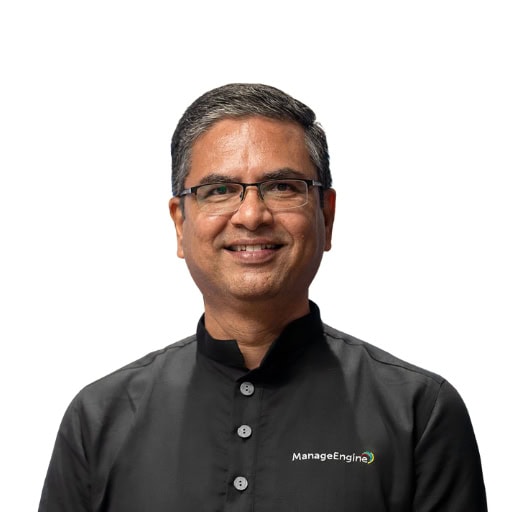
Rajesh Ganesan [00:00:00]:
Every business today is by default digital business. And you no longer operate within a secure perimeter. You have to be hybrid. You have to allow people to work from wherever they are. You need to let your business, data, critical data, flow freely where it needs to flow, which means you take complete accountability in terms of protecting data wherever it flows foreign.
Karissa Breen [00:00:39]:
Joining me now is Rajesh Ganesen, CEO at Manage Engine. And today we’re discussing AI anxiety in the Global science cyber balancing act. So, Rajesh, thanks for joining me and welcome.
Rajesh Ganesan [00:00:57]:
Thank you so much. Happy to be here.
Karissa Breen [00:00:59]:
Okay, so AI anxiety. Now I’m really interested to get into this because depends what you’re reading, who you’re following. There is a little bit of anxiety and angst around AI. So tell me more. What does that sort of bring up for you?
Rajesh Ganesan [00:01:15]:
Yeah, I mean, when we talk about AI anxiety, we are talking in the context of businesses, right? Right. In the personal life, AI is already there. We are using it, we are utilizing it, we are seeing value there. We are not debating anxiety as much, but in the context of business, it raises a lot of questions. Right. So that is the context. I wanted to set the anxiety in the context of business using AI, multiple aspects to it. Right.
Rajesh Ganesan [00:01:43]:
So especially we have been talking about this idea of digital transformation for the last couple of decades. It’s been a journey, it’s been a long journey for businesses around the world. They’ve covered a lot of ground, a lot of distances, navigated technology disruptions. Every two, three years, one technology comes in. So it brings a lot of opportunities, but also a lot of anxiety as we speak. What I have set up so far, my business models, the channel through which I serve my customers, how do I receive payments, how do I empower my workforce, deliver all those services. Things go through a lot of change. And this is the anxiety that we are talking about.
Rajesh Ganesan [00:02:23]:
It comes in multiple dimensions, also from the dimension of the business executives, business owners on one side, the consumers, customers on the other side, and the workforce itself. Right. So they equip themselves in terms of particular area of expertise in technology. They have invested a lot of time, set everything up right. And suddenly there is a new technology coming up. Right. So this is the basic context I wanted to set. So again, talking about anxiety, for a lot of businesses, things are working okay.
Rajesh Ganesan [00:02:55]:
They have the workflows automated, they have their business functioning. Now, AI comes with a lot of Promise. At the same time, it is also unproven in the context of business, especially questions like how do you answer tough questions around cyber security posture, how do you handle questions about data privacy, data sovereignty, all of that. These are very important questions that businesses need to answer. The terms of service that they have, that they commit, they promise to their customers. And remember, so businesses are no longer local. There are very, very few businesses that can afford to remain local. Most businesses today are multinational, if not completely global.
Rajesh Ganesan [00:03:38]:
They are multinational, which means they need to comply to various laws of the different regions, different countries. Right. All of that make it very challenging, especially when it comes to how do they leverage AI best. Right. Talking about AI, there are multiple layers. We are already talking about traditional AI versus generative AI versus agent, pick AI and all of that.
Karissa Breen [00:04:02]:
Right.
Rajesh Ganesan [00:04:03]:
So as new avatars, new flavors of AI come in, how do people upskill themselves? How do they keep themselves relevant? How do they understand what potential, what benefits these technologies really offer, what use cases they can, they can really solve? Where businesses can see multiple benefits. Right. Many unanswered, unproven questions that sort of give rise to this anxiety. And that’s why we ventured into running a service specific to anz, the Australia, New Zealand region. And we have some perspective from few hundred professionals working across Anzar.
Karissa Breen [00:04:40]:
Okay, so going back to some of these questions being answered, do you think businesses are answering them today, like around privacy and security concerns, things that you mentioned before, Rajesh? So are people starting to answer them now or do you think there’s still a lot going on, that they’re just trying to keep their head above the water with AI and they’re trying to remain competitive against their competitive is or what’s going on here?
Rajesh Ganesan [00:05:03]:
So they have suddenly started answering, they started answering. So we are a technology company, we are a global technology company. We have started answering. But the problem is the pace of change that has been happening in this realm of technology. Generative A or agentic A, how definitions change. If you remember early 2025, we were all tracking the industry. Almost every week there’ll be a new large language model coming into the industry. Right.
Rajesh Ganesan [00:05:32]:
So from different parts of the world, you’ll have companies from the US talking about a model and suddenly you are seeing deep sea coming out of China, breaking all the benchmarks that we had seen with OpenAI, with the likes of OpenAI and then you see LLMs coming out of Europe and inside India, including companies like ManageEngine and Zoho. We are all building our own large language models. Narrow language models, so to speak. So the point is that the pace at which things are changing, when we were still getting to figure out how do we use generative AI, conversational AI, we are already talking about Agent tk, which is you are talking about having a workflows that is completely digital. Like you have human employees, you are going to have the equivalent digital employees. So as you start to answer one question, we are seeing more questions pop up. That is the real challenge here. Kariza.
Rajesh Ganesan [00:06:27]:
So if you are going to have digital employees, how do you treat them right? So what entitlements do they have? What accountability do they have? How do you really treat them right? So you make that one employee do the work of 100 or thousand or 10,000 human employees. What hem say can work, right? What information that they can see, process completely autonomously, which is when you will really get to see the benefits, right? So these are questions that we are grappling today. But when it comes to using the technology per se, some questions have been answered. Like I said, we as a company took some starts, right? If you have to really use generative AI in the context of business, sending data to a third party AI infrastructure, it’s going to make things very challenging in the context of security and privacy. So we invested in building our own very context specific, so manage engine, we target the CIOs, we sell to CIOs inside enterprises. So our model, our language model will be built, tuned specifically to solving IT problems, right? So we are able to give a commitment about how the data will be processed, what it will be used for, where it is stored. Without those commitments, it’s very hard to answer security and privacy questions. And this is what we recommend companies also think about, right? Because today you have many, many options, so to speak, right? So even within generative AI, for normal conversational AI, some models are good for image and video generation.
Rajesh Ganesan [00:08:02]:
You have other models doing really, really well for summarization data analysis, for generating software program, we are talking about models like Claude or interfaces like Cursor. So you have many, many options. Are you going to use all of them or are you going to pin down where you are going to use this? Do you have this Clarity is the question we ask ourselves, we ask our customers. And this is the path that we are still trying to pave forward for us, right? So some questions have been answered, but lot remains to be answered yet.
Karissa Breen [00:08:35]:
Okay, so the next thing I want to ask you about now is what do you mean by confidence in its use remains uneven? So what’s uneven.
Rajesh Ganesan [00:08:46]:
Specifically when we say like confidence level being uneven. In this context of the survey, one thing is between how is the confidence level between companies that are still small and mid market versus big and enterprise companies. Right. So that is the primary difference we mean when we say this being uneven, the confidence level being uneven. So what we have seen because of the capital that big enterprises can invest, because they can clearly see, I personally believe, I have the conviction the AI technology today at least the generative AI has gone beyond just being hype. It is useful, it is able to really solve very good problems. We have seen ourselves the benefit it can give in terms of doing first level customer support or generating completely new code for building new features. It is able to deliver value.
Rajesh Ganesan [00:09:42]:
But not all companies today have the means. First in terms of deploying capital, let’s face it, in the context of business, for you to consume AI the kind of compute that that it requires, not all companies can afford. So there is a bit of uneven landscape that exists between small and big companies and also people’s talent level of how they can consume these technology to sort of really see leverage right there. The skill gap that we are talking about that is a lot uneven. Without the capital being invested, without the talent being available, without the clarity of the use cases, without the clarity about how do you bring AI, autonomous AI, intelligent AI into business workflows. In a way it is increasing the productivity and not causing any disruption. These are questions the bigger enterprises are able to answer much better as opposed to smaller companies. So there is a bit of imbalance there where the confidence levels VCE is much higher in bigger enterprises, whereas in the medium and small businesses this level is still low.
Rajesh Ganesan [00:10:57]:
They know what they can achieve using AI, but they don’t have the means today either in the form of capital or in the form of talent or having the knowledge clarity to what they should choose when I follow the experts, right? So sometimes people throw advice like this, right? So go find a model that does reasoning better, right? I don’t think it’s a very useful advice because every context is very different. Every business is different. The problem they are trying to solve is different. The region that they are operating out of has very specific needs. So the confidence level, to summarize the survey finds that it’s very high in medium and large businesses. And on the opposite side the confidence levels are not much high. And that is the unevenness we are talking about here.
Karissa Breen [00:11:43]:
And would you say just generally speaking, smaller to medium sized businesses, they are taking AI easier, better, faster than like big enterprises are. Because whilst I’ve heard enterprises are adopting AI, there’s still a big machine and you know, there’s a lot more, it’s a lot more regimented than a. More of a smaller nimble business. Right. So just, I know you have to give specifics, but just generally where does your, where does a consensus sit on that?
Rajesh Ganesan [00:12:13]:
Yeah, I mean specific areas. Kariza, when you are a startup, you are obviously wanting to be very nimble. So say you are a technology startup building a software product, software as a service product there, using something like Claude for generating all your code really, really helps. And when you are a small company, when you are not really global yet, when you are not dealing with selling to government agencies, big businesses, you still can afford to like not 100%, but you still can afford take security and privacy postures. Not as much as the enterprises, right? So they have some leeway there. So that is where it can help. They can move fast, they do the releases faster, they have small nimble teams, that’s what we see. They are able to adopt.
Rajesh Ganesan [00:13:07]:
But as things move fast and as their customer base increases and they become big, you have all the speed breakers coming in, right? So you have to take security, privacy, data protection, data leak prevention, all of this very seriously, right? On one side we are talking about consumption of AI inside ethical environments like businesses. But let’s also remember generative AI is a very powerful tool in the hands of hackers too, right? So how can these small companies invest in security tools, securing their infrastructure? That remains another challenge, right? So this is why we talk about this whole anxiety thing, right? On one side I have a lot of promise, lot of potential, already able to see value. But on the other side, I see a lot of road bumps not letting me move as fast I want to, right? And these problems are completely in different dimensions for small companies as opposed to the big companies. But from what we have seen, like we are 18,000 employee company, we speak to customers, both small and big, they want to move fast, but the challenges for each one of them are very, very different. And you know, it all depends on how we navigate those challenges. Karisa, what I have been speaking about.
Karissa Breen [00:14:31]:
And would you say the anxiety around not adopting AI is greater than the anxiety towards adopting AI?
Rajesh Ganesan [00:14:41]:
I would say like the pessimism about AI is coming down drastically, right? So I always see technology leaders, business leaders, most of them, right? So I cannot put a number here, but in all the conversations they have a clear plan. So especially in 2025 when we speak to Customers, most of them have a clear roadmap with respect to how they are going to bring AI into their business functions, business operations. Right. Which means they are not even thinking about not using AI. Right. So let’s be very clear about that. So there is, I don’t see any anxiety of not using AI. So this is something I’ll be safe to claim today for all the businesses.
Rajesh Ganesan [00:15:28]:
Like how every business today has to be a digital business very soon or even now the digital includes AI. Also, we don’t have an option of not using AI. So the anxiety is more about I want to use AI, but it comes with a lot of challenges. How do I navigate the challenge? Right. So do I have enough expertise? Do my people have the right skills? And people inside, they already are using AI, they are putting a lot of effort and back in their mind they know all the effort that I put to bring AI deploy AI may make me obsolete. Right. So sometime later in the future, these are the anxiety factors that we see more and more. And it’s definitely not about not using AI.
Rajesh Ganesan [00:16:17]:
This is something I can say very clearly.
Karissa Breen [00:16:19]:
Okay, so then just to go into that a little bit more. So for example, what we’ve seen in the news recently, these big, big technology players, they’re laying off a bunch of stuff, but then they’re also following it up with saying, hey, yes, we’re laying off these people because we’re going to reinvest in other ways. Reinvestment, meaning AI. Etc. And then you said before, do I as a company have enough expertise? I mean the answer to that is probably no because it’s still relatively new skill set. Right. And you mentioned before jesh about people upskilling and all these sort of things. So would you say that now because people are worried about their jobs? And I’ve heard that, but then it’s about, well, depending what job you’re in, then obviously there’s more potential anxiety around losing it.
Karissa Breen [00:17:03]:
But are you now seeing that these businesses that you’re talking about here, they are still investing money, but in, in this, in the AI arena and then they, they’re funneling a lot of their staff to upskill to have that knowledge around it. So whilst people think that businesses are laying off, they’re not like necessarily investing, but they’re just investing in other ways.
Rajesh Ganesan [00:17:24]:
Exactly. That’s something I agree with. So, so today I talked about having the clarity, right? So as we have done things in the last five, 10 years in the context of business, we are going to change, right? It’s not just the technology work. A company has a lot of business functions. You have the legal function, you have the sales, marketing functions, customer support functions, inside marketing. You have the design function, you have the copywriting function. Think about all of this. AI can do a much, much better job, immediate job.
Rajesh Ganesan [00:17:55]:
But does it mean design? All the designers are going to lose their job. All digital marketers are going to lose their job. Like anyone who does copywriting will lose their job. No, right? So someone still has to give a prompt. There has to be an original idea that get generated somewhere. So that is one aspect, Kariza the other one. We are just getting started with AI, right? So today when you think about the AI infrastructure, what do we see? Right? So we have OpenAI, we have Azure from Microsoft, there is Google and there Gemini, there is Meta, there is Deep Sea. Very, very few think about Internet 1.0 or early 90s when the world was building Internet, right? So there was no Internet infrastructure.
Rajesh Ganesan [00:18:42]:
Once we built that infrastructure, the first five years I remember was using just the dial up lines, right? That enabled only certain functions to be done. I still remember Yahoo being a website with only static links, right? So today I will compare the AI infrastructure to the Internet 1.1 infrastructure. As the world evolves, investing more and more, as we speak, we look at these big technology companies, right? They are like betting really big on building a infrastructure. We are going to do it right? So once the infrastructure investments go in to even build, operate and run the infrastructure, we need a lot of people. And once we have a much more capable infrastructure, it will throw up lot more newer possibilities, newer options like what we saw with web 2.0, web 3.0 and then the mobile phone wave came and the social media wave came and all of that. This is what I expect to happen in this industry. I’m an optimist when it comes to technology. Of course we’ll have problems with generating power, cooling and all of this.
Rajesh Ganesan [00:19:51]:
And you see Google talking about setting up data centers on the space, right? So that’s a grand vision, great vision, right? So you put all those satellites in the orbits, the data centers are going to be outside this planet. So you never run out of power because you are directly consuming from the sun, right? So you are directly in the line of sight with the sun. Always all 24 hours power is there. You don’t need cooling because you are in the orbit. So we are thinking like that as an industry. So when that happens, people will be empowered to be solving much more complex problems. And I don’t think we’ll be worried about losing jobs. It obviously this is the face of like going through the anxiety, crossing the anxiety cosm, as I would say, because we have done things in a particular way for the last five, 10 years, that is going to change.
Rajesh Ganesan [00:20:44]:
But people that adapt, people that change, people that can upskill themselves. I will equate this to how the journey of Internet was over the last 20, 30 years. It’ll be the same for AI, right. So the possibilities that it is going to give you options that it can unlock will be humongous. Right. So even though you have anxiety, just, just navigate. We’ll have a lot more work to do going forward. Is.
Rajesh Ganesan [00:21:10]:
Is how I see this planning out there.
Karissa Breen [00:21:12]:
Okay, so this is interesting because. And I want to, I do want to spend time talking about this because again, when I’m speaking to people, whether they’re in the industry, they’re just slightly adjacent to it. They are asking a lot about job displacement. Whilst I’m an optimist as well. Rajesh, I think there definitely will be roles that aren’t around anymore. But I sort of look back through, like, through history that certain roles don’t exist anymore anyway. So, like, are people upset about it? Do you think that we just can’t necessarily see the future and we don’t have hindsight yet to look back and think, well, makes sense that we don’t have that role anymore. But equally, I mean, there are still a lot of.
Karissa Breen [00:21:48]:
There’s still a lot of roles out there that maybe should be automated or can be or will be in the future. But what do you think the biggest displacement anxiety around roles comes from? Is it because people, like, don’t want to upskill? Because sometimes, especially if you go to university and you’ve got all these degrees or whatever it may be, maybe people are like, well, I’ve done all of that now and I don’t want to learn a new skill because unfortunately human beings are creatures of habit. But I’m just curious to maybe understand, like, what is it specifically that people are anxious about? Because I wasn’t doing. I mean, I used to send faxes in my very first job, right. And that wasn’t that long ago. That was only about 15 years ago, really. But if I said that to, you know, a younger person today, they probably wouldn’t know what a fax was. So.
Karissa Breen [00:22:34]:
But I’m not upset that I’m not sending a fax anymore. I’ve just learned that, you know, this is evolution of our society. So I’m just curious to Understand what, what is it that is giving people this anxiety around the displacement?
Rajesh Ganesan [00:22:47]:
You know what, in my observation, this is a personal observation. The anxiety comes from. I have invested in learning a particular skill and I’ve settled in my life doing that. And I am entitled to be doing the same thing for 30, 40 years, right? So unfortunately, when a lot of people think any change that happens in the world is very unfair on them, that is where this anxiety stems from. Kariza, in my own experience, people that have really succeeded, done well in life, have really adapted to the changes that had happened around them, right? Every two, three years you really have to reinvent yourself, look for new problems. You cannot assume things won’t change around you. The only thing that you. This is a cliche, right? The only thing you expect is all the things around you will change.
Rajesh Ganesan [00:23:38]:
If you have that mindset, this anxiety could be easily be handled, right? Truth be told, to be very honest, 2022, when OpenAI came up with ChatGPT, it did give us all a lot of anxiety, right? If this particular tool can do all these jobs, generating code to writing content to doing customer support, you throw a medical record, it’s able to give really good medical advice, as good as any trained physician, or ask any legal question, anything from able to answer it does give you anxiety, but you cannot live with that anxiety forever, right? So you need to reset at some point and move on, which is where knowing a bit of history also helps. Like you said 20 years ago, fax machine was a big deal even before. I know like companies used to have someone operating their telephone network inside, getting the calls and routing manually inside the companies. And I’d seen that in the US in mid-90s. And where did that job go? They are maybe doing a much more valuable job up the chain today, right? So the anxiety really comes from a lot of people not wanting to change. But we all have no options. We all have to change. People that change fast, that adapt fast, will succeed faster.
Rajesh Ganesan [00:25:01]:
That’s how we can conclude this. If you get into addressing the anxiety for everyone that feels anxiety, we will not be making progress with all the promised potential that this new technology brings in, right? We are not just talking about automating road things, we are talking about this generative AI like inventing cure for long standing medical problems, right? So we are talking about this being able to do really, really great investigation forensics, which otherwise will take months and years to do, think about all the benefits. So we really need to do this. But you cannot be stuck at addressing the anxiety the majority of the people feel right, like when I said, I’m a technology optimist. We have seen three, four disruptions like this before. The term cloud did not exist before 2002. And we were already 10 years into the technology industry as a company. We navigated the cloud disruption, we navigated the virtualization disruption.
Rajesh Ganesan [00:26:03]:
And also technologies like blockchain come and go without making any impact. So same is the case with AI. Three years later there’ll be something else. And we are already talking about AGI, all of that. Right. So my point would be anxiety will be normal, natural, but you cannot get into addressing it. To the last person that has the anxiety, it is not polite to say maybe, but they will also change. We will move on, Right? As the global civilization, we will be moving on.
Karissa Breen [00:26:33]:
Yeah. So this is interesting. So what I’ve been hearing from people like yourself, Rajesh, there’s this undertone around when the cloud came in or when virtualization, there was this resistance. There’s always going to be resistance with anything that you do. Right. So are people just going to get beyond that and just accept, okay, well, AI is here to stay? And I keep saying to people, it doesn’t matter how you feel about it or what will used to happen, it’s, it’s here now. So you just, we just got to move on. So do you think that with any new technology that comes, and like you mentioned before, AGI and all that’s going to, you know, it’s coming through now as well.
Karissa Breen [00:27:04]:
There’s always going to be people that are resident, that are hesitant, that are negative towards it. People are going to adopt it, People aren’t going to adopt it. But now it’s just, you have to, to stay ahead to, to get, to win that next job, to stay competitive with your competition, for example. So I want to lead into my next question around that. Is there any sort of specific regions that have been more hesitant to adopting AI? Is there some that are a little bit more leaning into it? Like, I’m really curious to understand what that looks like.
Rajesh Ganesan [00:27:36]:
Yeah, so that is an important question too. Regions that have less regulation, they are able to move much faster. This is something you could have observed in the European Union’s countries, specifically Western Europe, where you have a lot of regulation. There is a lot of resistance in terms of how fast they can move. We are already talking about the EU a lock, right? So like we have GDPR for data protection and data privacy. There is going to be a lot of regulation around what AI can be used for. You need to have a lot of guardrails talking about how ethical the AI implementation is. You have to prove the model does not have any bias before you even start to deploy and start to using the technology.
Rajesh Ganesan [00:28:24]:
You have to spend a lot of effort proving a set of points. So that’s what regulations do. That is the difference. I see Karisa, that is the number one. The second factor is obviously the kind of capital each region has. Certainly, if you see North America is getting a lot of investment. And interestingly, a region like India, where we operate from, could have seen news about how Google and Microsoft and Meta, all these companies are investing heavily in India, building data centers, building power plants, building infrastructure for AI. Because as a region, we have 1.5 billion people where there is market, right? So where, because as we speak today about AI, a lot of investments are flowing in as a business problem.
Rajesh Ganesan [00:29:14]:
Companies have still not figured out a way to sort of see the ROI that they really want to see. Hundreds of billions of dollars are getting invested, but in terms of revenue that they make from this technology, it’s still not that high. So the other factor that determines AI adoption is how viable the market is. So these are some of the factors that I see that sort of has an impact of how AI is adopted in different regions. Regulation is one, and also the capital availability and also the market and audience relevance. All of these are for it.
Karissa Breen [00:29:52]:
Yeah. Okay, now that’s interesting. And then so to touch on this a little bit more, do you, has any of this surprised you though? Like if you had a hypothesis in your mind that you’re like, okay, I was a little bit surprised with that.
Rajesh Ganesan [00:30:04]:
Or not really, Honestly, I’m not surprised. Right. Because this is also becoming a bit geopolitical. We, we cannot go much deeper into that. So talking about national security, this is also a conversation we are starting to have already. Road infrastructure, Internet infrastructure, your power infrastructure, AI infrastructure is going to be very, very critical for every nation, right? Because let’s face it, models are, even though we talk about artificial intelligence and this being super powerful and all of that, end of the day models are nothing but a piece of algorithm, piece of code running in machines that does compute, right? So these are software programs trained to operate in a certain way, right? So they can be trained to give wrong responses, they can be as they call, they can be poisoned, bias can be injected, all of that, right? So this is also an important factor. So I am not surprised when the European Union wants to have high regulations, right? Why some of the countries where they do not have as strict regulations wanting to move fast, right? So none of this is a surprise. And countries like China not just building models, right? So they are thinking end to end, they want to build their own GPUs, their own chips, right? So in, in that sense it’s extremely interesting times how things are happening.
Rajesh Ganesan [00:31:30]:
It’s not just about technology anymore. It is about business, it is about national security. The dimensions are really going to affect from a lot of different directions. It’s interesting to follow but I won’t say any of this is a surprise.
Karissa Breen [00:31:43]:
Theresa and then so what do you think sort of moving forward then Rajesh? Do you think that AI will become the great equalizer or what do you sort of think now? Because one thing, if I just look as an example, smaller companies or newer startups, it’s giving them an opportunity and it’s equal out the playing field, right? So that we are seeing smaller companies being birthed that are overtaking large ingrained businesses as well, which is quite interesting to watch from the sidelines. So what do you sort of think then moving forward? How’s this going to unfold and how do you sort of see it?
Rajesh Ganesan [00:32:14]:
I mean I, I wish it’s, it’s going to be an equalizer, but there I’ll be a little guarded in terms of being very optimistic. Karisa because of the point I mentioned for the previous question. In terms of capability, if everyone had the same level of access to the AI technology, it is indeed an equalizer. But if some countries, some nations, some big tech companies are going to have monopoly, this is also a conversation that will really get intense. I don’t see the equalization becoming very smooth because last year we were talking about the supply chain delays with respect to the Nvidia chips. There’s one company that was delivering all the GPUs, right? So now what happens? And also saw people like Satya Narala talking about last month, I have more than enough chips that I need, but I don’t have enough power, right? So who’s going to generate all the power? So and then comes the whole idea of building this complex infrastructure, right? So as we speak we still have to figure all these things out, right? So as global civilization, so I cannot jump and say it is already going to be a great equalizer. I’ll just wait and watch how things happen. So that is something, this is a question I’ll be very guarded in terms of making any prediction, right? So Internet was an equalizer, right? When it really became accessible to everybody across the world.
Rajesh Ganesan [00:33:47]:
But the Same example applies here as we speak today. The level of access to AI technology is not the same. Unless that happens, I don’t see how it can be a complete equalizer regardless of the size of the company, the location, region, the people. Right. So that is still a big question mark there.
Karissa Breen [00:34:06]:
And then one thing I’d like to sort of close with today, Rajesh, is you’re a cricket fan and I want to talk to the theory around one lapse in concentration can cost you a wicket. So people who are cricket fans will be familiar with what I’m talking about. But now if we can sort of relate this then to cyber security. Now for a moment, what’s the equivalent to that proverbial slip that attackers are sort of waiting for? Just to give some context.
Rajesh Ganesan [00:34:34]:
Yeah, I mean, cricket is a easier context. We, we give a different example. When you are an agent, when you are a company, having your own defense is very, very important, right? So you have threats coming from external side all the time. They are going to try a million times and all they need, all they are expecting is try once out of that million time, right? And that creates a big, big damage for you. But you as a person defending your territory, you have to win Every million times that they are, they are attempting to attack you. All you need is to fail once for the defense to break and the catastrophe to happen. That is the same thing with cricket, right? So you could be, you could be playing 100, 150 balls. All it takes is one ball to get dismissed.
Rajesh Ganesan [00:35:21]:
So apply in the context of cyber security businesses today. I keep repeating this. Every business today is by default digital business and you no longer operate within a secure perimeter. You have to be hybrid. You have to allow people to work from wherever they are, which means you need to let your business, data critical data, flow freely where it needs to flow, which means you take complete accountability in terms of protecting data wherever it flows. And you have to assume when you set some infrastructure like this, when the model changes to data flows freely everywhere, you have to assume. This is the principle of what we talk about as zero trust today. You have to assume a breach has happened.
Rajesh Ganesan [00:36:10]:
You have to assume you are under attack all the time, which means you cannot afford to fail even once. Attackers, their philosophy is very simple. They keep trying millions of times and all they are expecting is this one incident that can succeed out of a million times. They want this one unassuming user clicking a wrong link right out of a company of 20,000 people. They keep trying for a year. All they need Is one person clicking a wrong link and downloading a malware into the network is all it takes to completely take the cyber security posture out of the window. This is the idea of advanced persistent threats, right? So they find one gullible, unassuming user, get their way in. They can then move laterally inside the network, have access to critical business assets, digital assets and all of that.
Rajesh Ganesan [00:37:03]:
So which is why we always talk about this analogy in cricket or in defense. All it takes is one ball to get you dismissed. All it takes is one security incident to bring your this whole business dog. You just cannot afford to make it happen that one incident happened. So that’s how it goes.
Karissa Breen [00:37:22]:
Would you say as well, Rajesh, people are thinking like that though, or would you say that it’s not thinking about it perhaps enough or deeply?
Rajesh Ganesan [00:37:29]:
Unfortunately, unfortunately, not all of them are thinking that way. When we have this conversation with our customers, some people assume I’ve done a lot of hard work, I’ve deployed a lot of tools, I’ve trained my people. I don’t think I’ll be breached, right? So when we sit in such conversations, it’s very hard to explain because they assume they will never be breached. But thankfully, not all of them. Many CIOs see source, even business owners now understand the reality, right? So they know anything can happen. They are prepared. So I won’t say it is 100% yet. Some people still believe they are not going to fail.
Rajesh Ganesan [00:38:07]:
They are never going to be attacked until that one attack happens and they all wake up.
Karissa Breen [00:38:11]:
And then lastly, Rajesh, do you have any sort of closing comments or final thoughts you’d like to leave our audience with today?
Rajesh Ganesan [00:38:18]:
This is what we keep reminding ourselves. 2022 to 2025, last three years, the next one or two years, it’s all going to be about. The conversation will be about AI and all of that. So one thing we keep reminding ourselves is our business exists to serve our customers, which is we always want to understand what our customer problems are. We want to be clear about how best we can solve their problems. What is the best channels to serve our customers? This remains to be the primary focus for any business. As long as you do this, keep technology as the enabler for you to do this. We will all be able to navigate any technology disruption that comes our way end of the day, like we have been speaking the last 30, 40 minutes.
Rajesh Ganesan [00:39:05]:
Technology gives you a lot of capabilities, possibilities, but you are going to have challenges from many, many dimensions. How do you keep your focus? It is knowing your customers well their problems well, understanding your own business well have clear awareness of who you are, what you do, how you can change, how you can deliver better services and the focus remains strongly there from the leadership pushed from the top. Businesses really tend to succeed and I wanted to use the opportunity to emphasize that message a bit.
Karissa Breen [00:39:46]:
Thanks for tuning in. For more industry leading news and thought provoking articles, visit KBI Media to get access today.